October 20, 2026
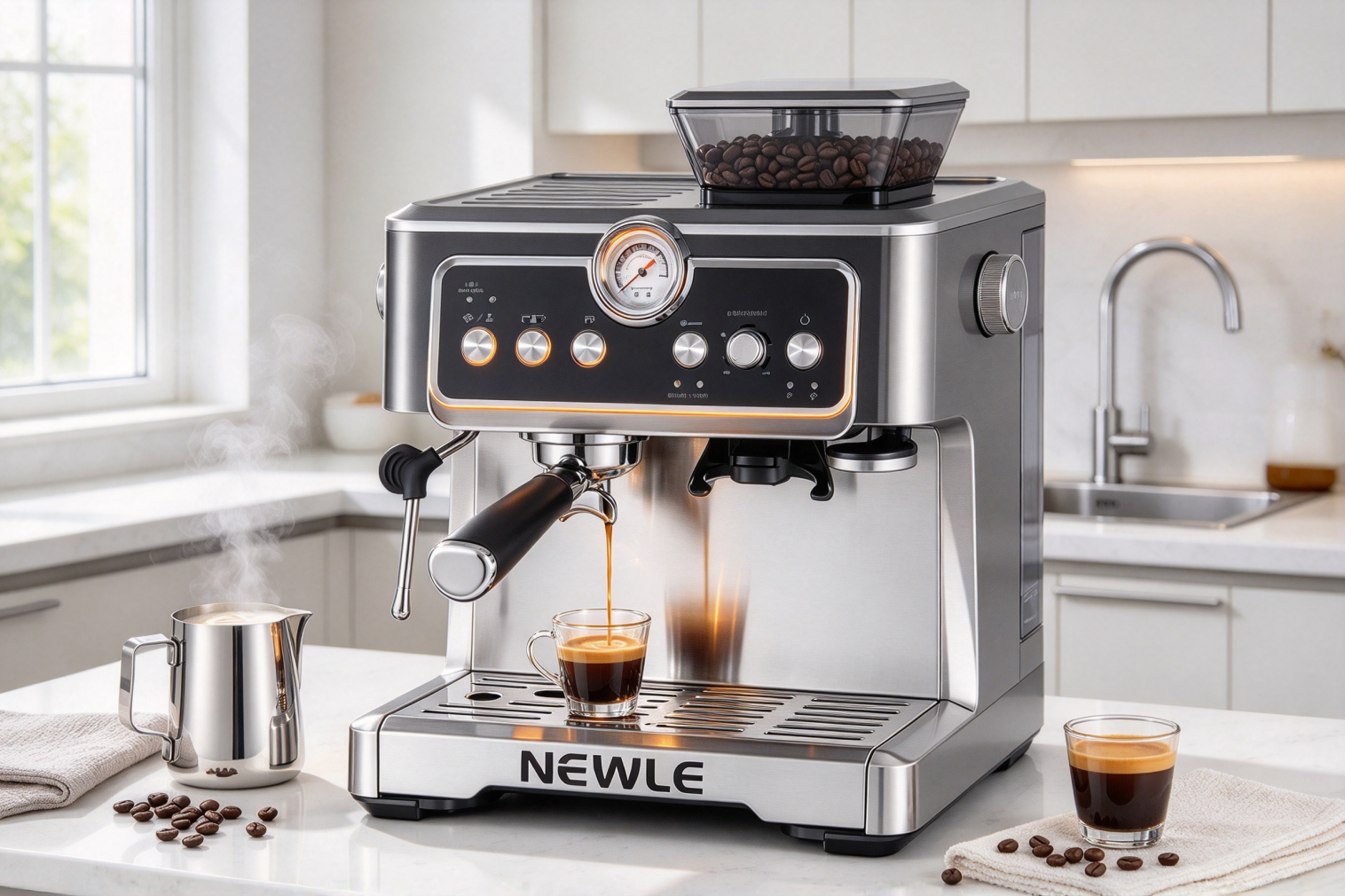
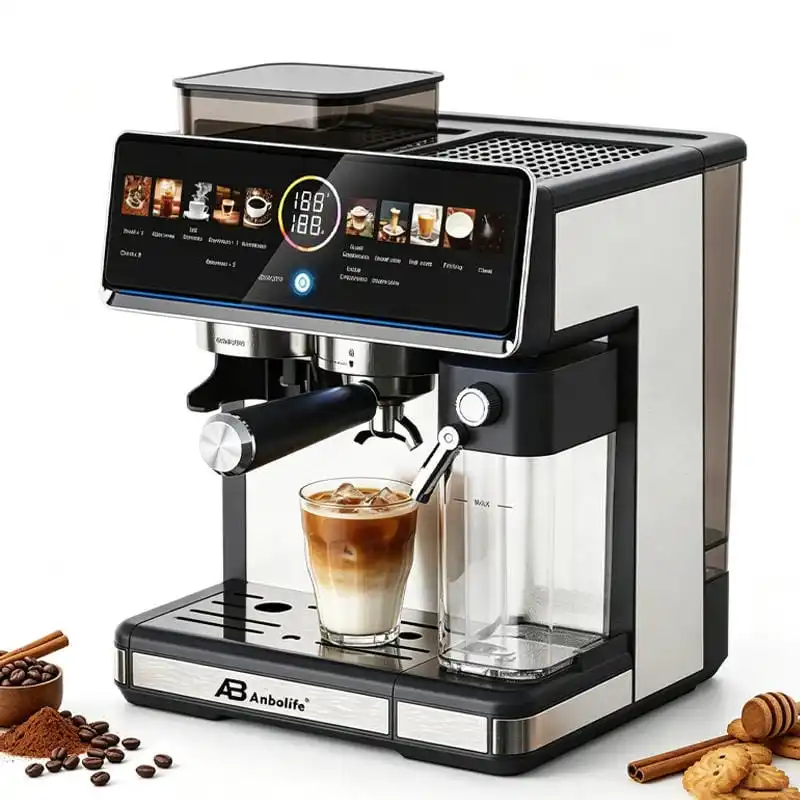 BC5705 bean-to-cup: 20-bar pump, 20 grind settings, 2.6 L water tank.
Four numbers decide whether a machine is genuinely commercial: brew-temperature stability under continuous load, a pump and group rated for back-to-back shots, a documented recovery time, and a spare-parts commitment measured in days rather than weeks. Ask for all four in writing before discussing price. A quotation that cannot supply them describes a household machine with a commercial label.
Hotel groups and coffee chains across Europe buy through distributors, and most distributors eventually evaluate Chinese OEM supply. What separates a workable partnership from an expensive mistake is rarely the machine on the sample table. It is whether the factory can document recovery performance, certification scope and parts flow — the three things that determine what happens in month six, not week one.
Three engineering choices separate a machine built for a counter from one built for a queue.
Heating architecture. A thermoblock heats water on demand through a narrow path. It reaches operating temperature quickly and suits low-to-medium volume sites. A dual boiler separates the brew and steam circuits, so steam pressure does not collapse while shots are pulled — the reason high-volume cafés pay more for dual-boiler units. Between the two sit single-boiler heat-exchanger designs.
Temperature control. Machines using NTC sensor control hold brew temperature within a tighter band than bimetal thermostats. That matters when the machine pulls dozens of shots an hour, because drift shows up in the cup before it shows up on any spec sheet.
Recovery time. This is the interval a machine needs between shots to return to brew temperature and pressure. It is the number most quotations omit, and the one that decides whether a machine serves a sixty-cup morning rush or only a breakfast counter.
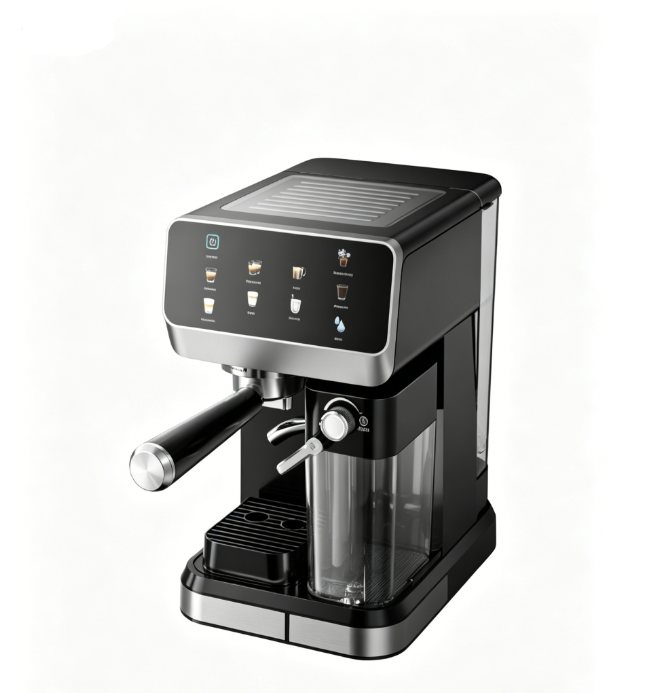
Anbolife builds both platform types: the BC5617 semi-automatic uses a thermoblock with NTC control and 20-bar rated pressure, while the BC5705 bean-to-cup pairs a 20-bar pump with NTC control, a 2.6 L tank and 20 grind settings.
Insist on measured values rather than adjectives. The table below shows the structure to require from any supplier, using two published Anbolife models as the reference format.
| Parameter | BC5617 semi-automatic | BC5705 bean-to-cup | What to demand from any supplier |
|---|---|---|---|
| Rated power | 1350 W | 1350 W | Nameplate value and peak draw |
| Working pressure | 20 bar | 20 bar | Pump rating and group-head pressure at the puck |
| Heating system | Thermoblock | Thermoblock | Type, material, capacity |
| Temperature control | NTC | NTC | Sensor type and stability band (°C) |
| Water tank | 1.5 L, removable | 2.6 L | Capacity, plus direct-water option |
| Milk system | 500 ml tank, 360° steam wand | 500 ml tank, automatic frothing | Frothing method and cleaning procedure |
| Grinder | — (dual-wall 1/2-cup filters) | Integrated, 20 settings, 100 g hopper | Burr type and replacement interval |
| Recovery time | On request | On request | Seconds between shots at rated output |
| Continuous output | On request | On request | Cups per hour, with stated test conditions |
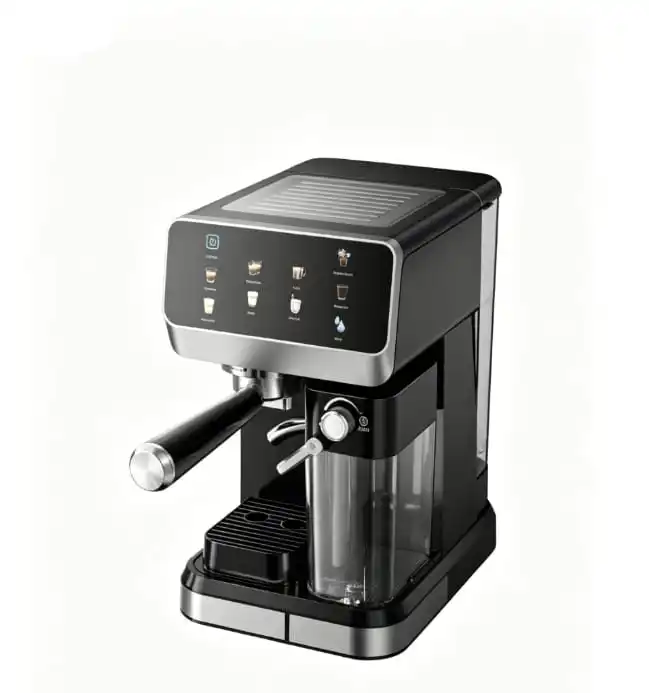 BC5617: 20-bar thermoblock with NTC control, 1.5 L tank, 500 ml milk tank.
Two rows in that table deliberately say "on request". A factory that cannot produce those figures once you ask has told you something more useful than a brochure.
Freight is priced on volume and weight, so carton geometry moves unit cost as much as the FOB price does. Ask for export carton dimensions and loading quantities per container — not the gift box alone.
| Item | BC5617 | BC5705 |
|---|---|---|
| Units per export carton | 2 pcs | 1 pc |
| Export carton dimensions | 48.5 × 33.5 × 40.5 cm | 350 × 340 × 420 mm |
| Gross / net weight per carton | 9.4 kg / 7.4 kg | 9.08 kg / 7.3 kg |
| 20GP loading | 900 pcs | 535 pcs |
| 40GP loading | 1,800 pcs | 1,070 pcs |
| 40HQ loading | 2,200 pcs | 1,360 pcs |
Read those columns against your sales forecast, not against the price list. At the same freight rate, a model loading 535 units per 20GP carries roughly 1.7 times the freight cost per unit of one that loads 900.
A machine that cannot be documented cannot legally be placed on the EU market. For a mains-powered coffee machine, the minimum set is:
| Document | Legal basis | What to check |
|---|---|---|
| EU Declaration of Conformity | LVD 2014/35/EU, EMC 2014/30/EU, RoHS 2011/65/EU | Model numbers on the DoC match the shipped units |
| CE marking | Same directives | Applied to the rating plate, not only the carton |
| Test reports | Harmonised standards under LVD and EMC | Issued by an accredited laboratory; scope covers coffee machines |
| GPSR responsible person | Regulation (EU) 2023/988 | An EU-established operator named on the product or packaging |
| Standby and off-mode data | Regulation (EU) 2023/826 | Declared consumption figure |
| WEEE, EPR and packaging EPR | National transposition | Producer registration per market you sell into (LUCID in Germany) |
Nordic and DACH distributors increasingly ask for the DoC and test reports before opening an order rather than after arrival. The practical question is not whether certificates exist, but whether the scope lists the exact model you are buying.
Parts availability is where a cheap quotation becomes expensive. Four clauses belong in the contract:
Compare total cost of ownership over twenty-four months, not unit price.
| Cost element | Chinese OEM structure | European brand |
|---|---|---|
| Unit FOB | Lower | Higher |
| Tooling and private-label setup | Separate line item — always ask | Often bundled or waived at volume |
| Spare-parts lead time | Depends on the SLA you negotiate | Usually shorter, priced higher |
| Certification transfer | Importer re-issues the DoC | Held by the brand |
| Support burden | Falls on the distributor | Shared with the brand's service network |
The honest summary: a Chinese OEM wins on landed cost and private-label flexibility, and loses on service-network depth unless the distributor is prepared to hold stock. That trade-off should be a deliberate decision made before signing, not a discovery in month eight.
Anbolife manufactures espresso, capsule and drip coffee machines for B2B buyers, including HoReCa distributors, importers and private-label brands. The coffee machine range covers semi-automatic and bean-to-cup platforms, with model-level specifications, carton loading data and certification scope available per unit.
Send your target model, market and estimated annual volume through the RFQ form and we will return the specification sheet, container loading figures and the certification documents that apply to your configuration.
What pressure rating should a commercial espresso machine have? Pumps are commonly rated at 20 bar. Group-head pressure at the puck is typically 9 bar for espresso extraction, so ask for both figures plus the pump's duty cycle.
How many cups per hour can a thermoblock machine deliver? Throughput depends on recovery time and tank refill rather than wattage. Without a measured recovery time and its test conditions, cups-per-hour claims cannot be verified.
Does a CE mark alone make a coffee machine sellable in the EU? No. You also need an EU Declaration of Conformity covering the applicable directives, test reports from an accredited laboratory, a GPSR responsible person established in the EU, and national WEEE and EPR registrations for each market.
What should a distributor request before placing a first order? The DoC, test reports, GPSR responsible-person details, WEEE and EPR numbers, a spare-parts list with part numbers, and carton loading quantities for each container size.
What MOQ and tooling cost apply to private-label coffee machines? Both depend on the model and configuration, and both should be quoted in writing. MOQ is normally driven by the packaging run rather than the assembly line.
Can a thermoblock machine serve a coffee shop chain? It can serve sites with moderate volume. For continuous peak-hour demand, compare recovery times directly and consider a dual-boiler platform; the specification matters more than the label on the carton.
Published 18 October 2026 · Anbolife Engineering Team






 EN